Important things to know
Breaking into a Data Science interview can feel overwhelming. You might have strong academic credentials, solid projects, and hands-on experience, yet your interviews still don’t convert into offers. If that sounds familiar, you’re not alone.
The truth is, Data Science interviews test much more than your ability to build models or write Python code. Employers evaluate how you think, how you communicate complex ideas, how you explain business impact, and how confidently you solve problems under pressure.
Many talented candidates miss opportunities not because they lack technical skill but because they approach interviews without a clear strategy.
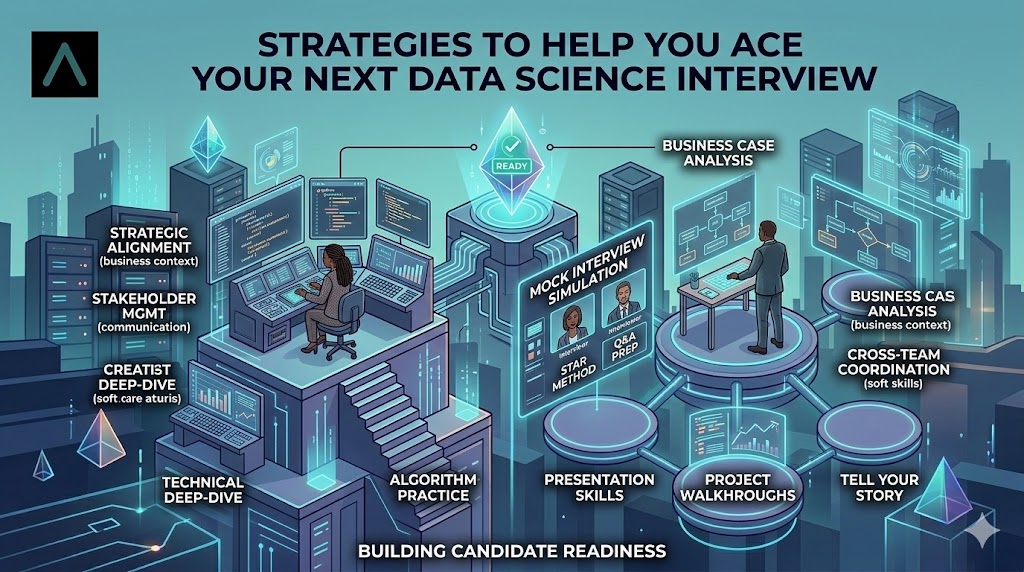
In this guide, you’ll learn practical, proven strategies to help you prepare smarter, communicate better, and perform confidently at every stage of your next Data Science interview from technical assessments to behavioral questions.
Catch up on our previous article on how to start a data science career without a computer science degree. Use this link.
Understanding the Data Science Interview Process
Before you dive into preparation, you need clarity on what you’re preparing for. Most Data Science interviews follow a structured process. Each stage evaluates a different skill set. When you understand what hiring managers actually look for, you can prepare with intention instead of guessing. Let’s walk through the typical stages and what companies assess at each one.
1. Recruiter or Screening Call
This is often the first step. It may feel informal, but it matters more than you think. During this call, the recruiter evaluates:
- How clearly you explain your background
- How well you articulate your projects
- Why you’re interested in the role
- Your communication styles
- Basic technical alignment
You should prepare a concise summary of your experience. Focus on impact, not just tasks. Instead of listing tools, explain what problems you solved and what results you achieved. Clarity and confidence go a long way here.
2. Technical Assessment
This stage tests your practical knowledge. Companies want to see how you think and how you apply your skills under pressure.
Common areas include:
- SQL querying and data extraction
- Python coding and data manipulation
- Statistics fundamentals
- Machine Learning concepts
- Model evaluation techniques
- Feature engineering
- Experiment design and A/B testing
However, modern Data Science interviews increasingly go beyond modeling.
Many companies now evaluate your understanding of:
- MLOps (Machine Learning Operations)
- Model deployment strategies
- Production pipelines
- Monitoring and model performance tracking
- CI/CD concepts for ML workflows
- Version control for models and data
You may get questions like:
- How would you deploy this model?
- How would you monitor model drift?
- How would you retrain the model?
- What happens if the data distribution changes?
Hiring managers want to know whether you understand the full lifecycle of a model not just how to train it. In simple terms, they want to see if you can take a model from a notebook into production and maintain it responsibly.
3. Case Study or Practical Problem
In this round, you solve a real or simulated business problem.
You might receive:
- A dataset to analyze
- A product scenario
- A growth or retention problem
- A forecasting challenges
Here, interviewers assess:
- How you structure ambiguous problems
- How you define assumptions
- How you prioritize metrics
- How you communicate insights
They care less about perfect answers and more about structured thinking. You should explain your reasoning step by step. State assumptions clearly. Walk them through trade-offs. Think out loud. Structured thinking often matters more than technical perfection.
4. Behavioral and Stakeholder Round
Many candidates underestimate this stage. At this point, companies already believe you can do the technical work. Now they want to know if they can work with you.
Expect questions about:
- Handling difficult stakeholders
- Working in cross-functional teams
- Managing tight deadlines
- Dealing with failed models
- Making decisions with incomplete data
Use the STAR method (Situation, Task, Action, Result) to structure your answers. Focus on impact and learning. Show ownership. Demonstrate growth. Remember, Data Science is rarely a solo job. You must explain complex ideas clearly to non-technical stakeholders. Strong communication can be the deciding factor between two technically equal candidates.
Understanding these stages changes how you prepare. Instead of studying everything at once, you can now align your preparation with the exact skills each stage tests.
How to Prepare Strategically (Not Randomly)
Now that you understand how Data Science interviews are structured, the next step is preparation. But here’s where many candidates go wrong. They prepare without a clear plan. They jump between topics, watch endless tutorials, and revise everything at once. That approach feels productive, but it rarely leads to real improvement. Instead, you need focused preparation that aligns directly with how interviews are designed.
The strategies below will help you prepare smarter, build confidence, and walk into your next interview with clarity and control.
Strategy 1: Strengthen the Foundations That Actually Matter
You don’t need to know every algorithm. You need to master the fundamentals that interviewers repeatedly test.
Focus on:
- Writing clean SQL queries
- Manipulating data confidently in Python
- Explaining key statistical concepts in simple terms
- Understanding how common ML models work
- Knowing when to use each model
For example, you should confidently explain:
- The difference between bias and variance
- How regularization works
- When to use classification vs regression
- What evaluation metrics to choose and why
Keep your explanations simple. If you can’t explain a concept clearly, you don’t understand it well enough yet. Depth beats breadth every time.
Strategy 2: Think Beyond Modeling: Understand the Full ML Lifecycle
Modern Data Science roles expect more than notebook experiments.
You should understand how models move from development to production.
At a basic level, you must be able to explain:
- How you would deploy a model
- How you would monitor performance
- How you would detect model drift
- How you would retrain models
- How version control applies to data and models
You don’t need to be an MLOps engineer. But you should understand how your work fits into a larger system. Employers want Data Scientists who think end-to-end.
Strategy 3: Practice Structured Problem Solving
Case studies are not about perfect answers. They test how you approach ambiguity.
When solving a problem:
- Clarify the objective
- Define assumptions
- Identify key metrics
- Outline your approach
- Discuss trade-offs
Always explain your reasoning out loud. Interviewers want to see how you think, not just what you know. Structured thinking creates confidence and clarity.
Strategy 4: Communicate with Impact
Strong communication separates average candidates from exceptional ones.
When describing your experience:
- Focus on outcomes, not tasks
- Quantify results when possible
- Avoid technical jargon unless necessary
- Adapt explanations for non-technical audiences
Instead of saying:
“I built a classification model.”
Say:
“I built a classification model that reduced customer churn by 12%.”
Impact makes your work memorable.
Strategy 5: Practice Like It’s the Real Interview
Preparation isn’t reading notes. It’s simulation.
You should:
- Solve problems under time pressure
- Practice whiteboard explanations
- Record yourself explaining concepts
- Do mock interviews with peers
- Review your past projects deeply
Many candidates fail because they prepare passively. Active practice builds confidence.
Data Science interviews are challenging, but they are predictable. When you understand the structure, strengthen your fundamentals, think beyond modelling, and communicate clearly, you dramatically increase your chances of success. Remember this: Interviews don’t just test knowledge. They test clarity, structure, and confidence.
You don’t need to be the smartest person in the room. You need to be the most prepared.
Start preparing with intention, focus on what truly matters, and treat every interview as a skill you can improve not a judgment of your worth. Your next opportunity may be closer than you think. Take our 1-minute job readiness test to examine your readiness to land data science careers. Click here.