Important things to know
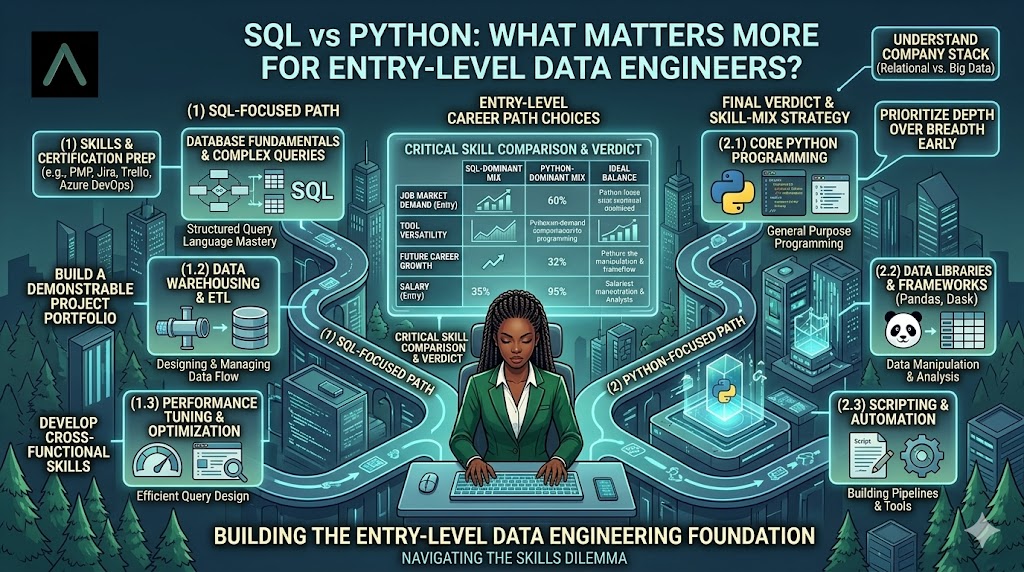
If you’re trying to break into data engineering, you’ve probably asked this question: Should I focus more on SQL or Python? It’s a fair question, especially when job descriptions list both, often without explaining the difference in expectations, but after looking closely at entry-level roles and working on real data systems, I’ve come to a clearer conclusion. The answer isn’t “both equally. And it’s not as complicated as people make it.
The Reality of Entry-Level Data Engineering
At the entry level, companies are not hiring you to design distributed systems from scratch. They’re hiring you to:
- Write reliable transformations
- Query data correctly
- Debug broken pipelines
- Understand how data flows from source to warehouse
- Support analytics or reporting teams
Most of that work touches SQL constantly. Python appears too, but often in a different capacity.
Why SQL Is Foundational
Data lives in databases.
And SQL is the language of databases.
If you can’t do the following, then you will struggle in most real data engineering environments.
- Join tables confidently
- Aggregate correctly
- Handle edge cases in grouping logic
- Write window functions
- Understand query performance
In many early-career roles, your daily work might involve writing transformation queries, creating warehouse models, debugging metrics, and validating data consistency, all heavily SQL-driven.
Watch the replay of our session on how to land your first US Tech job in 90days.
Where Python Actually Comes In
Python becomes important when:
- Building ingestion scripts
- Working with APIs
- Handling semi-structured data
- Writing orchestration logic
- Automating repetitive tasks
At the entry level, you’re rarely designing large-scale Python systems from scratch.
You’re often modifying existing scripts or writing supporting utilities.
Python matters but SQL depth is usually more immediately tested.
The Skill That Really Differentiates Candidates
What hiring managers often look for isn’t who knows more syntax but the following;
- Who understands how data behaves
- Who can reason about edge cases
- Who can detect when a metric is wrong
- Who thinks about reliability
Strong SQL skills demonstrate structured thinking while strong Python skills demonstrate engineering thinking.
If you have to allocate learning time for an entry-level role:
- Get very comfortable with SQL: joins, window functions, modeling logic, and performance awareness.
- Build solid working knowledge of Python: scripting, APIs, file handling, and pipeline basics.
SQL gives immediate leverage while Python expands scope over time.
The debate isn’t really SQL vs Python. It should be more about understanding versus automation.
SQL trains you to think about data structure and logic. Python helps you build systems around that logic.
At the entry level, understanding usually comes first and strong SQL is often the clearest signal that you have it. What truly marks a skilled data engineer and the one who gets called for interviews, is the experience that person B has gained actually working on this tool. Knowledge gained from experience differs from knowledge gained from training and that is why our Data Engineering work experience program was built; to help you gain the experience recruiters need from you. Find out how you can join a cohort by booking a free clarity call with our team here.