Important things to know
Deciding between SOC and GRC is a bit like choosing whether you’d rather be a firefighter or a city planner. Both are essential for keeping the community safe, but your day-to-day life will look completely different depending on which one you pick.
As we move through 2026, the cybersecurity landscape has shifted. It’s no longer just about "hacking"; it’s about where you fit in the ecosystem. Here is a human-centered look at the five key factors that will help you decide which path fits your personality and goals.
1. The Daily Vibe: Action vs. Strategy
SOC: The Frontline Defenders
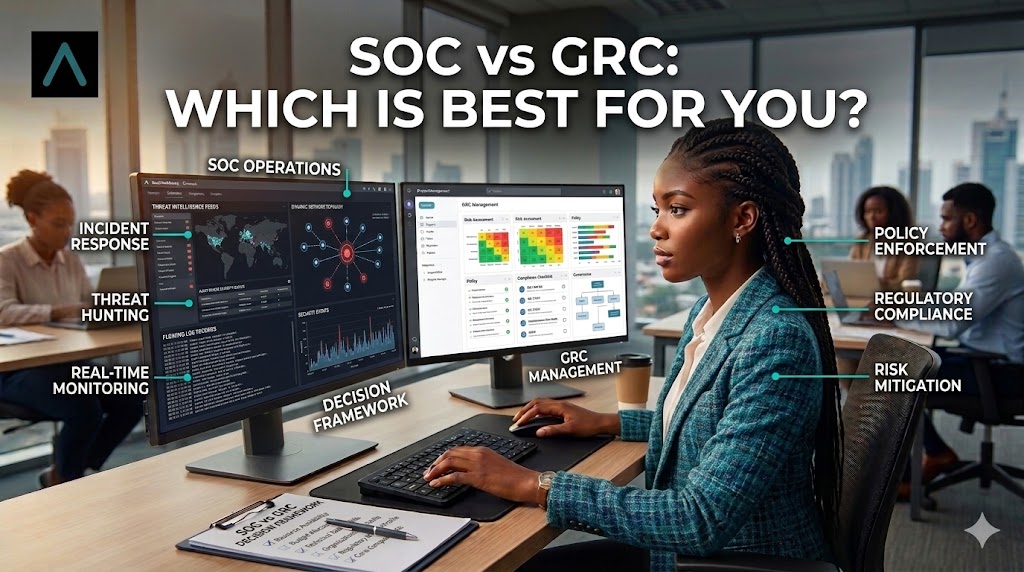
If you work in a Security Operations Center (SOC), you are a cyber first responder. Your day is driven by real-time events. You’re monitoring dashboards, investigating weird spikes in traffic, and jumping into action when a breach is detected. It is fast-paced, technical, and can be quite an adrenaline rush.
Common tasks include:
Watching SIEM dashboards for red flags
Digging into malware or phishing attempts
Hunting for hidden threats in the network logs
Containing active security incidents
GRC: The Architects of Trust
Governance, Risk, and Compliance (GRC) is the "big picture" side of security. Instead of catching a hacker in the act, you’re building the fortress so they can’t get in to begin with. You spend your time thinking about laws, company policies, and long-term safety.
Common tasks include:
Running risk assessments and audits
Ensuring the company follows rules like GDPR or ISO 27001
Writing the "playbook" (security policies) for the whole company
Presenting security needs to lawyers and executives
The Quick Takeaway:
If you love solving technical puzzles under pressure, go SOC.
If you enjoy planning, organizing, and influencing strategy, go GRC.
2. Your Toolkit: Deep Tech vs. Broad Analysis
The SOC Skill Profile
SOC roles require you to be a bit of a technical detective. You need to understand the "guts" of a computer system. You’ll spend your time getting cozy with:
Networking and how data moves
Windows and Linux operating systems
Command lines, scripting, and automation
Specialized security tools like EDRs and firewalls
The GRC Skill Profile
GRC is more about communication and critical thinking. You still need to understand security, but you don't necessarily need to know how to write code. Your strengths will be:
Understanding complex regulations
Risk management and business logic
Writing clear, professional reports
Explaining technical risks to non-technical people
3. Career Growth: Where Do You End Up?
In 2026, both paths offer incredible longevity, but the destinations differ.
The SOC Path usually leads to deeper technical mastery. You might start as a Tier 1 Analyst and move up to become a Lead Incident Responder, a specialized Threat Hunter, or a Security Engineer who builds the tools the SOC uses.
The GRC Path often leads toward leadership. You might start as a Risk Specialist and grow into a Security Consultant or eventually become a Chief Information Security Officer (CISO), where you’re helping run the entire organization.
4. The "Gut Check" Personality Fit
Be honest with yourself about what kind of work actually makes you feel energized at the end of the day.
| The Question | SOC | GRC |
|---|---|---|
| Do you thrive in high-pressure "emergency" situations? | Yes | Not usually |
| Do you enjoy writing detailed documentation and reports? | No | Yes |
| Would you rather use a tool than attend a meeting? | Yes | No |
| Do you want to influence how a business makes decisions? | No | Yes |
5. Stability and Demand
The good news is that by 2026, both roles are "recession-proof."
SOC demand is high because cyberattacks are getting more frequent and aggressive. Companies need people who can fight back. GRC demand is skyrocketing because governments are passing stricter privacy laws, and companies are legally required to prove they are staying safe.
Interestingly, many people start in a SOC to learn the technical "truth" of how attacks work, then move into GRC later in their careers. This creates a "Power Hybrid" professional who is highly respected in the industry.
Which One Is "You"?
There is no "better" choice, only the choice that fits your life. If you want to be in the thick of the action, the SOC is waiting. If you want to be the person who designs the strategy and keeps the organization on track, GRC is your home.
At Amdari, we know that reading about a career is different from living it. Our internship programs are designed to give you a taste of both worlds. We provide the mentorship and real-world environments you need to see where you truly shine. Book a free clarity call with our team to know how. Click here.