Important things to know
If you’re working in a non-tech role and thinking about moving into data science, you’re not alone. A lot of people come from backgrounds like marketing, finance, HR, operations, or sales and start wondering the same thing: “Can I actually break into data science without a computer science degree?”
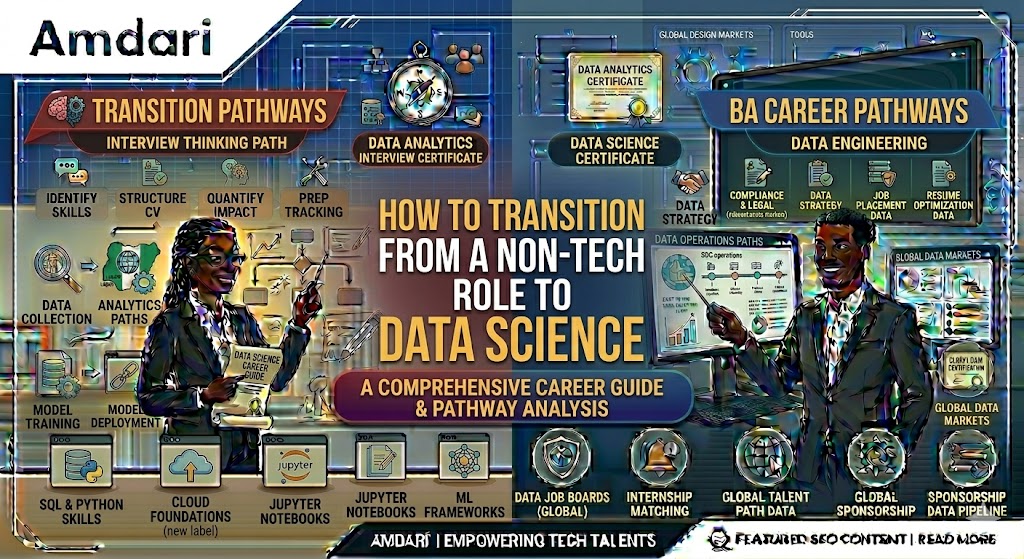
The short answer is yes, but the longer answer is more important. The field has evolved. Data science today is no longer just about building models in notebooks. It now includes data engineering awareness, deployment thinking, and exposure to production systems. However, that doesn’t mean you need to learn everything at once. It means you need a structured progression. This guide breaks down exactly how to transition realistically in 2026 without getting overwhelmed.
Why a Non-Tech Background is Not a Disadvantage
One of the biggest misconceptions is that you need a technical background to succeed in data science. In reality, data science is a mix of three things:
- Business understanding
- Data interpretation
- Technical implementation
People from non-tech roles often already have strong domain knowledge, which is something pure technical learners usually lack.
For example:
- A marketing professional understands customer behavior
- A finance professional understands risk and forecasting
- An HR professional understands workforce patterns
Data science becomes powerful when you combine that domain knowledge with data tools. So your background is not something to “fix”, it is something to build on.
What Data Science Looks Like Today
Data science has evolved into a layered discipline:
1. Data Analysis Layer
This is where most beginners should start. It includes:
- Excel and data exploration
- SQL for querying data
- Python for data manipulation (Pandas, NumPy)
- Basic visualization tools
This layer is about understanding data and extracting insights.
2. Machine Learning Layer
This is the core of traditional data science:
- Supervised and unsupervised learning
- Model evaluation and validation
- Feature engineering
- Building predictive models
At this stage, you start answering questions like:
“What will happen next based on this data?”
3. Production Awareness Layer
Modern data science roles now expect some awareness of how models are used in real systems. This does NOT mean deep engineering expertise, but you should understand:
- How models are turned into APIs
- How predictions are consumed by applications
- What happens after a model is trained
- Basic understanding of version control (Git)
This is where the industry has shifted. Employers increasingly want data scientists who understand the lifecycle of a model beyond training.
4. MLOps and Software Engineering Layer
This is where things like Docker, CI/CD pipelines, orchestration, and monitoring come in.
Important clarification:
You are not expected to master this at the entry level. However, awareness is becoming more important earlier in your career than it used to be. Companies want data scientists who understand how models move from experimentation to production, even if dedicated MLOps engineers handle the heavy lifting.
So instead of thinking of MLOps as a starting requirement, think of it as a growth layer that you gradually build into.
A Step-by-Step Roadmap for Transitioning
Step 1: Identify Your Transferable Skills
Start by mapping your current role into data terms:
- Marketing: customer segmentation, campaign analytics
- Finance: forecasting, risk modeling
- Sales: conversion analysis, performance tracking
- HR: employee analytics and retention trends
This helps you realize you’re not starting from zero, you’re translating experience into a new language.
Step 2: Build Core Data Foundations
Before jumping into machine learning, focus on fundamentals:
- Excel for quick analysis
- SQL for data extraction
- Python for data cleaning and manipulation
- Basic visualization tools like Power BI or Tableau
This stage is critical because most real-world data work happens here, not in machine learning.
Step 3: Learn Machine Learning Gradually
Once you’re comfortable with data handling, move into:
- Regression and classification
- Clustering
- Model evaluation techniques
- Simple predictive projects
At this stage, focus more on understanding than complexity.
Step 4: Start Building Projects Early
Projects are what make you employable, not just certificates.
Start simple:
- Sales performance analysis
- Customer churn prediction
- Product recommendation basics
Each project should show:
- Problem understanding
- Data cleaning
- Insight generation
- Basic modeling
Step 5: Build a Portfolio
Your portfolio is your resume in action. You can use:
- GitHub for code
- Colab for notebooks
- Notion or a simple website for presentation
Employers want to see evidence of thinking, not just learning.
Step 6: Learn “Production Thinking”
At this point, start understanding how models leave notebooks:
- What is an API?
- How does a model serve predictions?
- What does it mean to deploy a model?
- Why do systems need monitoring?
You don’t need to master implementation yet, you need awareness.
Step 7: Apply While You Learn
One of the biggest mistakes people make is waiting until they feel “ready.”
You don’t need to be perfect to start applying for:
- Data analyst roles
- Junior data science roles
- Internship positions
Learning and applying should happen together.
Common Mistakes to Avoid
Many beginners slow down their progress because of avoidable mistakes:
- Jumping into machine learning too early
- Ignoring SQL (this is heavily used in real jobs)
- Watching tutorials without building projects
- Trying to learn everything at once
- Avoiding communication and storytelling skills
Data science is not just technical, it is also about explaining insights clearly.
How Long the Transition Really Takes
The timeline depends on consistency, but a realistic expectation is:
- 2–4 months: strong basics if consistent
- 5–12 months: job-ready with projects and practice
What matters most is not speed, but consistency. Even 1–2 hours daily is enough if focused properly.
Transitioning from a non-tech role into data science is absolutely possible, but it requires structure, patience, and the right expectations. The field has evolved. It is no longer just about learning to build models, it is about understanding data, solving business problems, and knowing how insights move into real systems. You don’t need to learn everything at once. You just need to start with the right foundations and grow step by step with practice. Amdari has helped several skilled professionals in Data and other tech career paths to gain experience, build their portfolio and increase their confidence. Some have even gone on to land jobs because of the low risk-work experience program. You can watch some testimonials here. Speak to our team of Career Consultants to enquire what next step is best for you at the point you are in your career switch. Click here to book a call. Your background is not a limitation. In many cases, it’s your advantage. Learn more about our Data Science work experience program here.