Important things to know
HR Analytics is no longer a niche function. Organisations are now using data to answer critical workforce questions:
- Why are employees leaving?
- What drives performance?
- How much will payroll grow next year?
- Where are burnout risks increasing?
- What skills will we need in three years?
As demand grows, more professionals from finance, operations, psychology, IT, and even marketing are looking to transition into HR Analytics.
But the way ahead is not always clear.
Here’s how you can tackle it in a strategic manner.
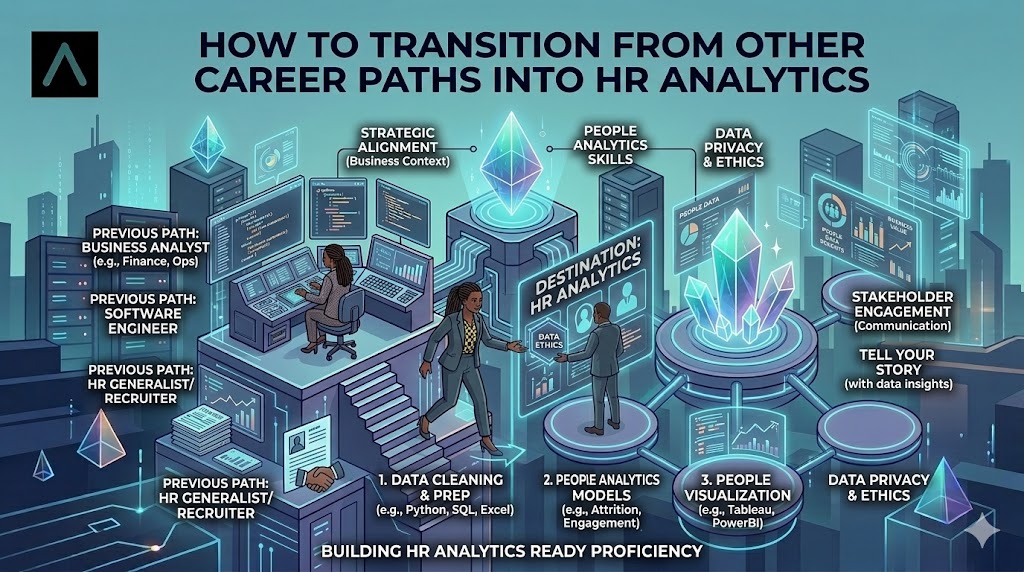
Understand What HR Analytics Really Is
Before making the transition, you need to understand the function in a proper manner.
HR Analytics is more than HR reporting.
It extends to:
Headcount analysis
Absence management
Simple dashboard analysis
It is more about:
Workforce planning
Attrition analysis
Payroll forecasting
Skills gap analysis
Productivity analysis
It links people data to business strategy.
If you enjoy solving problems using data and influencing decisions, you are already aligned.
The question is not: “Can I make the transition to HR Analytics?” It is: “Am I ready to use data to solve workforce problems?” If the answer is yes, then the transition has already been made.
Identify Your Transferable Skills
Most people underestimate how much they already have.
If you are coming from:
Finance
You already understand:
- Forecasting
- Variance analysis
- Cost modelling
- Budget control
These are highly valuable in workforce cost planning.
Operations
You understand:
- Process efficiency
- Capacity planning
- Performance metrics
These translate well into workforce productivity analytics.
Psychology or HR
You understand:
- Behaviour
- Motivation
- Engagement
Combine that with data skills, and you become powerful.
Watch our podcast with Ruth Ijaola, a HR practitioner who shared insight on navigating the job market.
IT or Data Roles
You already have:
- SQL
- Data modelling
- Automation skills
You just need to understand HR metrics.
The transition is not about starting over.
It is about repositioning your existing skills.
Learn the Core HR Metrics
To transition successfully, you must speak the language.
Key HR Analytics areas include:
- Attrition rate
- Cost per hire
- Time to hire
- Absence rate
- Headcount growth rate
- Payroll as % of revenue
- Employee productivity ratio
- Engagement score trends
If you can calculate and interpret these, you are already ahead.
Build Practical Projects
This is where most people fail.
They take courses.
They collect certificates.
But they do not build evidence.
Instead:
Create a simple HR dataset and build:
- A headcount dashboard in Power BI
- An attrition analysis in Excel
- A payroll forecasting model
- A scenario model for workforce expansion
Employers value practical evidence more than theory.
Learn the Skills That Matter
You don’t need it all.
- But learn:
- Excel (advanced formulas, PivotTables, modeling)
- Power BI (data visualization and DAX fundamentals)
- Basic SQL (optional but useful)
If you can:
- Clean data
- Create dashboards
- Interpret trends
You are employable.
Understand the Business Context
HR Analytics is not about dashboards.
It is about answering:
Turnover increasing in a particular department
Compensation costs rising
Skills gap
Diversity gap
Burnout risk
Remember to:
What decision will this analysis inform?
This is what differentiates analysts from report writers.
Take this 1-minute job readiness test to see how prepared you are for your next interview. Fun fact, you will see workable solutions to help strengthen weak areas. Click here
Rebrand Yourself Strategically
When making a transition, your resume and LinkedIn profile must evolve.
Don’t say:
“Finance Analyst looking to make a transition to HR Analytics.”
But say:
“Data-Driven Analyst with experience in workforce cost modeling and performance analysis.”
Position yourself in relation to analytics, not jobs.
Highlight:
Projects completed involving data
Dashboards developed
Forecasting models created
Insights offered
Your story should show progress, not puzzlement.
Entering the field of HR Analytics is not an identity change.
It is using your analytical talents for the good of the workforce.
The demand for people analytics is increasing in public sector institutions, healthcare institutions, universities, and business firms. There is a growing need for people who can connect workforce data to organizational strategies.
If you are serious about making the transition, remember these three things:
- Create useful projects
- Create expertise in Excel and Power BI
- Learn to think about workforce outcomes, not just numbers
And most importantly, do not make the transition alone.
Learning environments help to speed up the transition process.
The transition to HR Analytics becomes much simpler when you learn to combine technical knowledge with practical applications.
Amdari offers a low-risk work experience program for African immigrants to increase their chances of landing jobs. Click here to find out more.