Important things to know
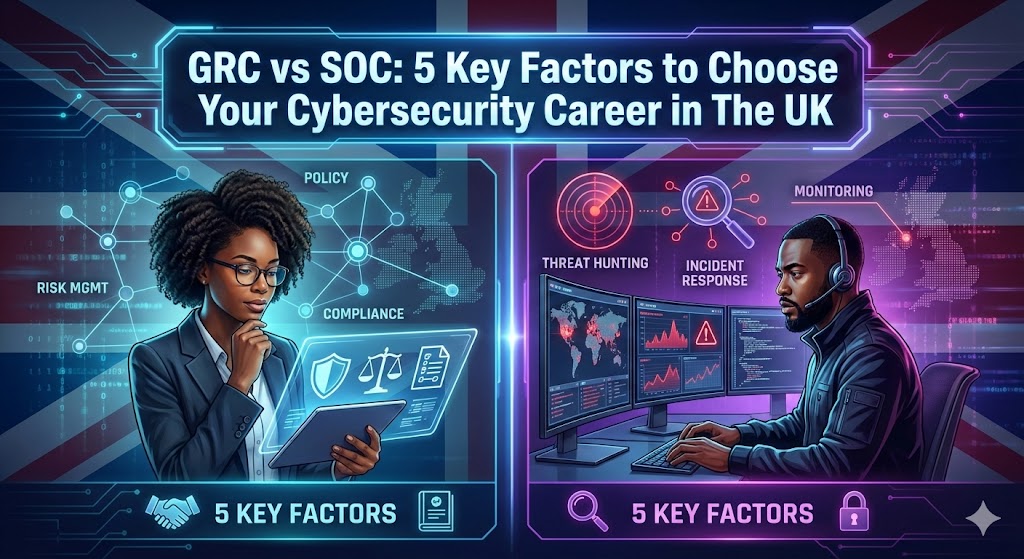
If you’re reading this, it means you’re ready to launch your career in cybersecurity, or at least seriously considering it. But you might be wondering: Should you pursue a career in SOC or GRC?
Which path fits your personality, skills, and long-term goals, and which offers the best growth and compensation?
In this post, we’ll break down 5 key factors to help you decide, plus share an opportunity to gain hands-on experience and fast-track your cybersecurity career.
But first,
TL;DR
(1) GRC focuses on governance, compliance, and long-term strategy. It offers stability, work-life balance, and clear career progression.
(2) SOC is hands-on and action-driven, perfect for those who thrive in fast-paced environments and enjoy defending against live threats.
(3) Both are in high demand in the UK, with GRC seeing steady growth and SOC roles experiencing a strong talent shortage.
(4) Start with CompTIA Security+ or Certified in Cybersecurity (CC), then specialize based on your chosen path.
(5) Choose GRC if you love structure and strategy; choose SOC if you enjoy solving real-time security challenges.
Both career paths offer exciting opportunities for career growth, so, where do they diverge?
Core Responsibilities
GRC professionals design and run the policies, controls, and processes that keep an organization compliant and well-governed. They map risks, align operations with legal and ethical standards, and ensure adherence to frameworks such as GDPR, ISO 27001, PCI DSS, and SOC 2.
On the other hand, SOC professionals defend in real time. They monitor, detect, and respond to threats as they occur, investigating and containing incidents such as malware, DDoS attempts, or unauthorized access. The focus is swift detection, clear escalation, and rapid recovery.
Career Outlook and Demand in the UK
In the UK, both SOC and GRC roles are in high demand, but for different reasons.
SOC roles are in hot demand, especially at entry and mid-levels. With cyberattacks growing daily, companies urgently need analysts who can detect and respond to threats in real time. It’s a fast-paced, high-pressure space where adaptability and technical skill are key.
GRC roles, on the other hand, are seeing steady growth driven by stricter regulations post-Brexit and ongoing GDPR enforcement. These positions offer long-term stability and attract not just tech professionals, but also those from legal, audit, or business backgrounds.
Key skills: GRC vs SOC
GRC is for you if you’re a detail-oriented person interested in how organizational governance and regulation shape cybersecurity, keeping organizations compliant, secure, and aligned with business goals. Key skills include:
(1) Risk management
(2) Understanding compliance frameworks such as ISO 27001, PCI DSS, and GDPR
(3) Strategic planning that ties security efforts to business objectives
(4) Auditing and reporting
SOC professionals, on the other hand, are the frontline defenders who detect, investigate, and respond to threats in real time. Their core skills include:
(1) Incident response
(2) Mastery of monitoring tools like SIEM, IDS/IPS, and firewalls to spot and stop breaches
(3) Threat hunting to proactively identify vulnerabilities before attackers do
(4) Communication and cross-functional collaboration
Certification and Education Pathways
If you’re new to cybersecurity, start with CompTIA Security+ or Certified in Cybersecurity (CC) by (ISC)², both provide a strong foundation in security principles and best practices.
From there, depending on your chosen path, here are the certifications ideal for the early stages of your career,
For GRC professionals:
(1) GRCP (Governance, Risk, and Compliance Professional): Introduces key GRC frameworks, risk management, and policy development.
(2) ISO 27001 Foundation: Covers the basics of information security management systems and compliance standards.
(3) CISA (Certified Information Systems Auditor): Great for those interested in auditing, controls, and governance once you have some experience.
For SOC professionals:
(1) Blue Team Level 1 (BTL1): Hands-on certification focused on real-world defensive operations and SOC fundamentals.
(2) EC-Council Certified SOC Analyst (CSA): Builds skills in SIEM monitoring, alert triage, and incident response.
(3) Splunk Core Certified User: Demonstrates practical knowledge of one of the most common monitoring tools used in SOC environments.
GRC vs SOC: What It’s Like Day to Day
The day-to-day experience in GRC and SOC roles can look very different. Understanding how each environment operates can help you choose the path that best fits your personality and career goals.
SOC professionals work in fast-paced, reactive environments. They monitor systems, respond to incidents, and collaborate with other teams to contain threats. The work is dynamic and exciting but can involve shift patterns and high pressure during active attacks.
GRC professionals operate in more structured, strategic settings. They focus on policies, risk assessments, and compliance planning, usually with steadier hours and better work-life balance. Career paths often lead to senior roles like Chief Risk Officer (CRO) or Compliance Director.
Conclusion
Both GRC and SOC offer strong career opportunities, the right choice depends on your strengths and goals.
If you prefer structure, strategy, and long-term stability, GRC is your lane. If you thrive under pressure and love hands-on defense, SOC is your arena.
Start with CompTIA Security+ or Certified in Cybersecurity (CC) to build your foundation, then specialize as you grow.
Whichever path you choose, the UK’s cybersecurity market is booming, now’s the time to skill up and start your journey.
Are you ready to get hands-on experience in any of these fields?
Join AMDARI’s Cybersecurity Work Experience Program to develop real-world skills with industry-standard tools and gain the confidence to thrive as either a SOC Analyst or an GRC Specialist .