Important things to know
Choosing between becoming a Data Scientist or a Data Engineer is one of the most common challenges faced by aspiring data professionals. Both roles are critical in the digital economy, but they serve different purposes within the data ecosystem. Understanding how they differ in focus, required skills, and career outcomes will help you make a confident, well-informed decision. And if you’re an African immigrant in the UK, US or Canada specifically, this choice can shape and future-proof your career in the growing data industry.
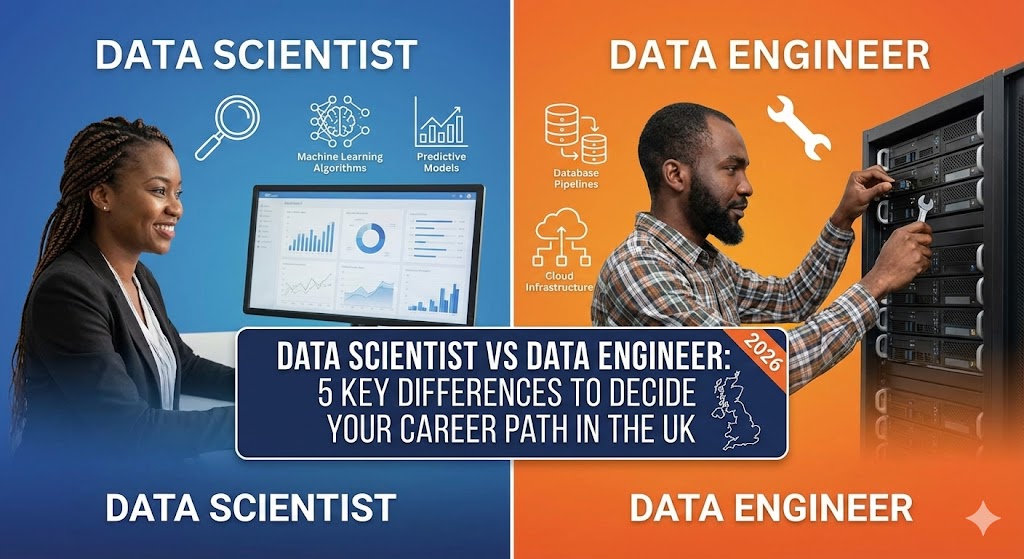
Who Is a Data Scientist?
A Data Scientist explores and interprets complex datasets to uncover insights, identify patterns, and build predictive models that inform business decisions. They combine statistics, programming, and machine learning to solve real-world problems. Unlike data analysts, who rely heavily on BI tools like Tableau or Power BI, Data Scientists focus on exploratory data analysis (EDA) using libraries such as Pandas, NumPy, Plotly, Dash, and frameworks like TensorFlow, PyTorch, and Scikit-learn. Their output often includes experimental models, data-driven hypotheses, and automated systems that power decision-making and innovation.
Who Is a Data Engineer?
A Data Engineer builds and maintains the data infrastructure that Data Scientists rely on. They develop data pipelines, manage storage systems, and ensure that data is available, reliable, and scalable for organizational use.
Their expertise spans cloud platforms, ETL (Extract, Transform, Load) workflows, and distributed data systems. Essentially, Data Engineers are the architects of modern data ecosystems transforming raw, unstructured data into a form that enables deep analysis and machine learning. Watch this video if your goal is to become a Data Engineer this year.
5 Key Differences Between Data Scientists and Data Engineers
| Feature | Data Engineer | Data Scientist |
| Primary Focus | Building and maintaining data systems and pipelines. | Analyzing and modeling data to extract insights. |
| Core Responsibilities | Designing ETL processes, managing databases, and ensuring data scalability and reliability. | Conducting EDA, building predictive models, and interpreting complex datasets. |
| Skills | Python, SQL, Java, Scala, Spark, Hadoop, Airflow, APIs, AWS, Azure, GCP. | Python, R, TensorFlow, PyTorch, Scikit-learn, Pandas, NumPy, Plotly, Dash, statistics, ML. |
| Goal | To make clean, structured data accessible for analysis. | To generate actionable insights and predictive intelligence. |
| Typical Output | Optimized pipelines and data architecture. | Predictive models, analysis notebooks, and visual insights. |
Career Outlook in the UK, US and Canada
Both roles are experiencing significant demand across the UK, US and Canada. Data Engineers are growing faster due to the rise of cloud computing, real-time data streaming, and AI infrastructure.
Data Scientists continue to be crucial in industries such as finance, retail, and healthcare, where predictive modelling drives innovation. If you love building systems and ensuring data flows seamlessly, Data Engineering could be your ideal path. If you’re passionate about algorithms, insights, and experimentation, Data Science is a natural fit.
Skillsets You Need to Succeed
Data Science Skills
- Core Skills: Python, R, SQL, statistics, machine learning, and data visualization.
- Frameworks & Tools: TensorFlow, PyTorch, Scikit-learn, Pandas, NumPy, Plotly, Dash, Jupyter.
- Mathematical Foundation: Linear algebra, probability, calculus, and statistical inference.
- Soft Skills: Problem-solving, curiosity, and storytelling with data.
- Optional Big Data Tools: Spark, Databricks, Hive.
Data Engineering Skills
- Core Skills: Python, SQL, Java/Scala, Linux, APIs, database design, and ETL.
- Cloud Platforms: AWS (Redshift, Glue), Azure (Data Factory, Synapse), Google Cloud (Big Query).
- Big Data Tools: Hadoop, Spark, Kafka, Airflow.
- Workflow Tools: dbt, Apache Beam, Luigi.
- DevOps Knowledge: Docker, Kubernetes, Git, and CI/CD pipelines.
- Soft Skills: System thinking, collaboration, and analytical reasoning.
Education and Career Pathways
Both roles usually start with degrees or strong backgrounds in Computer Science, Mathematics, Statistics, or Engineering. Data Engineers specialize in data pipelines, architecture, and cloud infrastructure. Data Scientists specialize in machine learning, data modelling, and algorithm design. If you are contemplating a career switch from another industry into tech, you will find this podcast insightful.
Bootcamps, online certifications, and professional training programs can provide theoretical learning and a faster pathway than traditional degrees but while certifications and coursework are vital, hands-on experience in Data Science and Data Engineering is what truly sets candidates apart.
Amdari provides opportunities for UK, US and Canada-based data professionals, especially African immigrants who need indigenous experience to increase their chances of landing jobs. Through Amdari’s practical work placements and projects, you can apply what you’ve learned in real business settings, collaborate with industry mentors, and build a portfolio that enhances employability in the UK tech market.
Choosing between Data Science and Data Engineering depends on what excites you most.
If you enjoy building robust data systems, pursue Data Engineering. If you thrive on exploration, experimentation, and modelling, choose Data Science. Both roles offer excellent salaries, career growth, and global opportunities, especially for African immigrants in the UK, US and Canada.
Your future in data starts today and the best way to begin is by booking a free clarity call with our team. Click here.